WHY ARE REGULATIONS NOT UNDERSTOOD BY SOME TRADE BODIES IN HEATING SECTOR?
Industry Commentary

Nathan G
April 15, 2026
Helping YOU find good heating engineers. We share case studies from engineers in the Guild of Master Heat Engineers to help people find top installers, help gas and oil engineers increase their knowledge around heat pumps, and provide a solution for third-sector professionals to understand the industry better.
Installio powers the The BetaTeach newsletter.
1. Introduction
YOU CAN LISTEN TO A SPECIFIC BETATALK PODCAST EPISODE THIS NEWSLETTER INSPIRED
In this 3 part issue I hope to achieve three things, as well as tell a bit of a story:
1) highlight how the building regulations actually work as SO MANY entities in the UK heating sector, especially manufacturers and their trade bodies such as the HWA and BEAMA, do not fully understand them. This is having a massive detrimental effect and impacting how we transition heating systems.
2) highlight how clever marketing has damaged scientific knowledge capacity across the whole sector.
3) highlight the difference between the UK and Germany regarding water quality.
I will be using the filter manufacture ADEY to illustrate my points. ADEY fascinate me. They have a wonderful, entrepreneurial origin story as we will see later.
If I were asked to pick just one manufacturer that I think could have the most impact in helping solve the skills gap (which is actually a symptom of a communications gap) it would not be a boiler or heat pump manufacturer. I think I would choose ADEY for a variety of reasons.
So…
PART 1: is going to be about who ADEY are and what they do.
PART 2: will discuss how the Building Act 1984, The Building Regulations and Approved Documents, such as part L, actually work. If manufacturers, such as Adey, continue to push out marketing material stating their products are “mandatory” then we have a real problem in this sector.
It’s the innovative engineers at ground level who are in the best position to understand current best practices. Not manufactures and not their trade bodies either. Thankfully, the world seems to have recently discovered how important the plumbing and heating industry is. Hopefully, the world will start to see the constraints good engineers are constantly battling with from within their own sector: poor information, poor information dissemination, poor marketing. There’s a simple solution of course: listen to the ground truth of the good engineers out there.
PART 3: Will look at the way German Standards (VDI) work and focus on the specific standard for water quality in heating systems, VDI 2035. It will juxtapose this with the UK standard around water quality: BS 7593
PART 1: Filters - they can be life saving.
Filters have existed in the heating industry for a VERY long time but Adey developed the first magnetic filter. Filters are everywhere in life. Your washing machine and dishwasher have them. Your car’s braking system, power-steering system and fuel system (if you use liquid fuel that is) have them. Refrigeration systems use them also. Systems which use any type of fluid (liquid or gas) need filters. They are vital. Even the natural gas flowing into homes has gone through filtration.
Of course, our body’s fluid (blood) needs filters too. If these don’t work it is very hard to live.
I spent around 10 hours on a cold November in 2008 (year of the Climate Change ACT) with my dad and two brothers all through the night in a hospital’s Intensive Care Unit. We were watching an expensive filter machine struggling to keep up with the septicaemia it was trying to remove from my mum’s blood.
As the eldest son of a long line of incredible matriarchs, my mum had instructed me that in difficult situations I’m the one who needs to be calm for the men. In fact, it was only my mum, her doctor and I who knew there was no possible cure for the particular type of myelodysplasia she had and that she would be dying very soon. It wasn’t this which killed her in the end; it was septicaemia which developed from her stoma bag.
The hospital staff in an ICU, who as some of you will know, are bloody amazing. They really, really are. They have to deal with family emotions at times of possible death. They realised it was going to be very difficult to explain to my brothers (both exceptional men) that at some point the filtration machine is needed back. They were clever enough to realise I was the one to speak to to convince the other men we needed to pick a time to switch my mum’s life off by switching the filter off. I chose sunrise. I love sunrise. I’m sure most of you readers do to.
My mum was very spiritual. This came from a place of deep resilience; her own father was a test pilot after the war and died in a test crash when she was only six. She was the eldest of three girls, just as I am the eldest of three sons. She has some Romany descent, which is a culture I’m sure some of you Peaky Blinders fans are learning a bit about from the recent film.

My Mum Janet (who my daughter is named after…they sadly never knew each other) and her Great Grandmother Louisa Walker “Gypsy Walker”
How Magnetic Filters Mesmerised the Market
The word "mesmerise" does not come from Latin or Greek. It comes from Franz Mesmer, an 18th-century physician who claimed he could heal people with magnets and "animal magnetism." He mesmerised people into believing something which was not happening. Look him up. But something good did come from this: Benjamin Franklin and Antoine Lavoisier were tasked by the King of France to investigate Mr Mesmer and his pseudoscience claims and they birthed the modern double-blind and controlled study.
Arguably, the company bearing the name of the magnetic filter’s inventor has unwittingly mesmerised the heating industry. When these filters first came about, merchants, colleges and training centres up and down the country received demonstration jars. They were cool and captivated people’s attention (before the days of scrolling). They engendered a ‘wow’ factor…but what is the actual science and physics of this product? Science being something our industry has put on the back burner for quite a number of years.
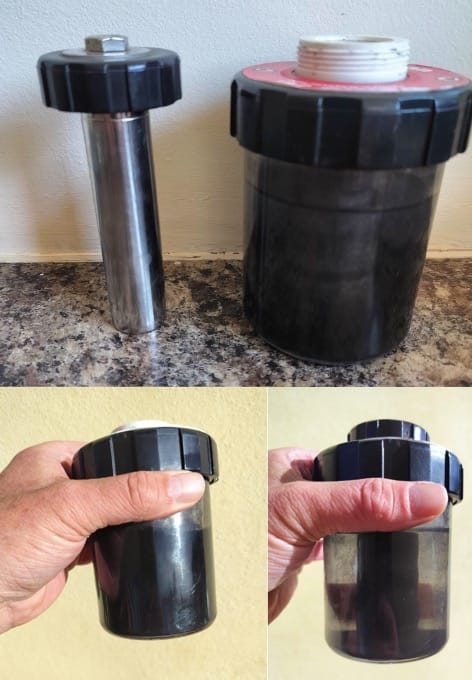
ADEY Demonstration Jar…give it a shake and watch the magic. In a demo jar the magnet is suspended inside a sleeve. In the real thing the magnet is suspend in the water. Unfortuanlty, despite ALL heating engineers knowing what a magnetic filter is, most won’t have understanding around water velocity, water conductivity or how temperature is related to the rate of corrosion. The marketing has been so powerful they believe you stick one of these on a system and you’ve done a great job
A Beautiful Entrepreneurial Story
I want to make something crystal clear: the rise of the Adey magnetic filter is a remarkable entrepreneurial story and in no way am I trying to discredit that. As you will see, I believe ADEY are in a special position to help get the UK heating sector back on track.
Chris Adey was a gas engineer and noticed water in a heating system could sometimes stick to ferrous metal so he decided to build a filter with a magnet. The story is he took it to the UK’s leading chemical inhibitor company Fernox to help him develop it. They said no so he developed it himself in his shed and created an empire. In my book that’s a brilliant achievement. The marketing behind the product was also brilliant but it arguably directed people’s attention away from the science of heating systems (a bit like the marketing of condensing boilers and controls did)
Before long, every person and their dog was manufacturing magnetic filters including Fernox (I think there are over 40 OEM products). If you are new to researching or having an interest in the UK central heating industry something you will learn very quickly: that if something sells, virtually every manufacturer will want to have it made for them and sell it also…whether it is useful of not.
A magnetic filter is useful but it does not do what ADEY thinks it does. A magnetic filter collects very fine particles of magnetite suspended in the water. In no way, shape or form does it prevent corrosion from taking place. Most of the corrosion which is taking place is happening in the steel (ferrous) radiators which just settles to the bottom of the radiator…no magnet is powerful enough to pull it from its resting place. It settles in the radiator due to the velocity of the water in a radiator (not to be confused with flow rate) being low. Think of a fast, raging river (high velocity). Its water would be murky if you were to collect a glass of water from it. This is because the sediment is constantly suspended in the water. Now think of a mill pond or a very slow moving river like the Everglades. Collect a glass of water and it will be much clearer. This is because the sediment has fallen to the bottom of the river.
A dirty heating system is inefficient. Radiators partially full with sediment/sludge are unable to output the required amount of Joules (heat) per second. The magnet does not prevent this sludge build up in radiators. It’s good at collecting the very fine particles still suspended in the water circulating around a system. In fact, a magnetic filter is actually a useful tool to prove systems are corroding. Lots’s of gunk on your magnet, your system is corroding more than it should. So what methods does the UK use to prevent such corrosion? Mmm…well one could write a book.
The UK is devoted (you can swap with the word obsessed if you wish) to chemical inhibitors. They came to merchant shelves the year I was born (1971) and yet millions of magnetic filters up and down the country are still showing that our heating systems are corroding. ADEY run the UK’s only UKAS accredited laboratory for testing inhibitors. They test other manufacture’s (their competitors) inhibitor. And guess what? Some of these inhibitors (despite having certification to be sold in the UK) corrode some metals (I’ve seen this with my own eyes at Adey’s lab). So, I’m sure you’ll agree that’s not a good.
It’s a bizarre industry. So, so many entities now sell inhibitor. It’s a heterogeneous mess of quality despite they all have the required certification to sell in the UK. There are main players who make inhibitors for these different entities like boiler companies, powerflushing companies and merchants. Our heating systems are constantly being bombarded and dosed with different inhibitors and chemical cleaners creating a chemical soup. Millions of bottles are sold yearly. Yet, systems carry on corroding. Guild Engineers et al who have switched to non-chemical methods to reduce corrosion are finding systems stay cleaner. And the chemical industry don’t like that. They want to keep people locked in to buying their chemicals.
Again, we must respect the origin of Adey. Chris Adey’s rise is a great entrepreneurial story: a gas engineer who was refused help by leading chemical inhibitor companies and built the solution himself. His success led to the 2021 sale to Genuit (formerly Polypipe). (For more on how corporate acquisitions change the technical landscape, see my previous newsletter on Mergers & Acquisitions here).
PART 2: Beyond the "Mandatory" Myth
As the Future Homes Standard takes effect in 2026, the heating industry is being flooded with "compliance" guidance. High-profile marketing campaigns, such as the recent email (below image) from Adey, a chemical inhibitor manufacturer, are explicitly using the word "MANDATORY" to describe the installation of specific water treatment products.
Simultaneously, BEAMA, a trade association for the electrotechnical and engineering industries, is launching a webinar series in partnership with Installer Online and Elemental. While these sessions are presented as educational, engineers must be careful and distinguish between commercial trade body interests and statutory law.
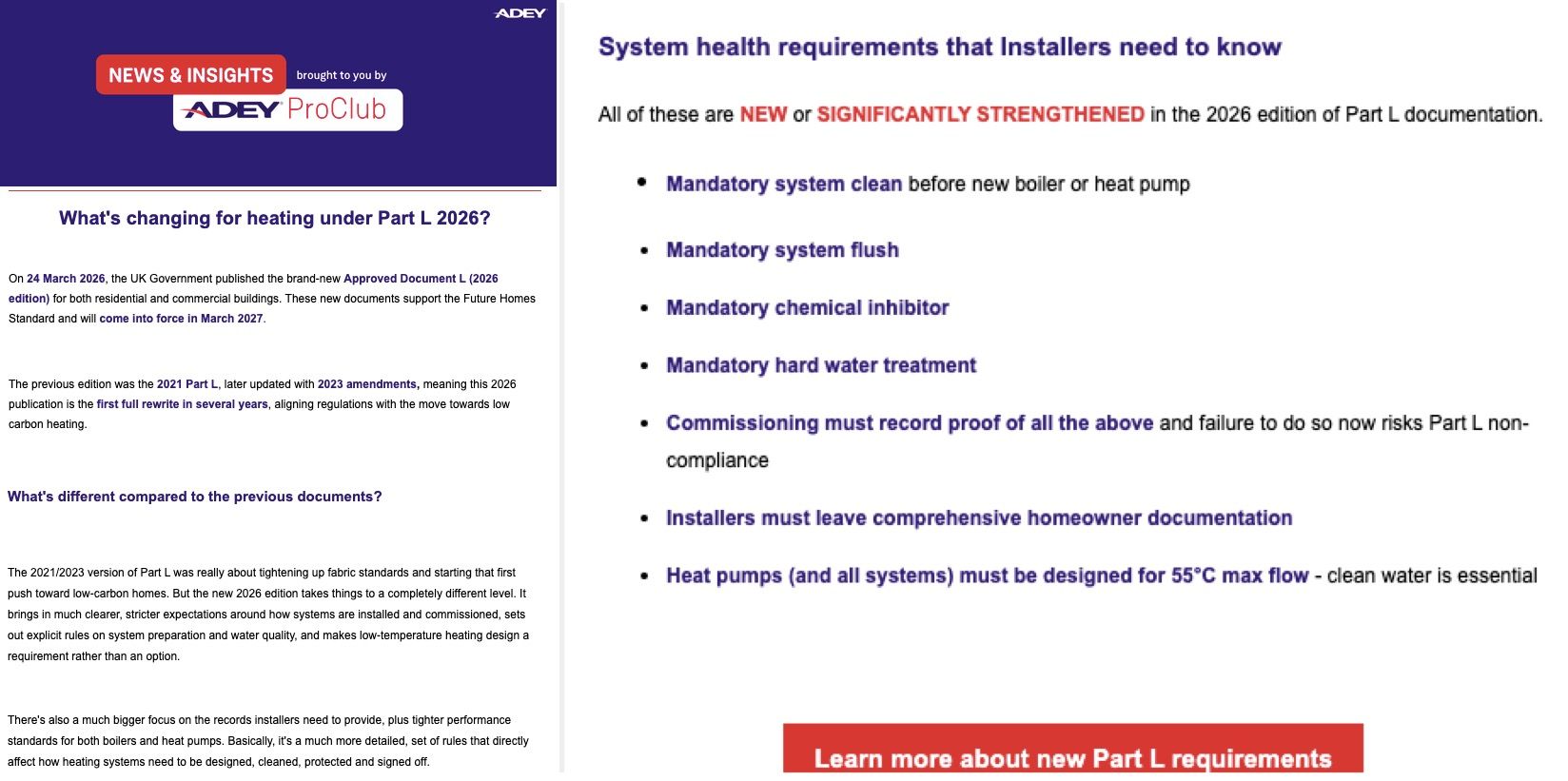
"Guidance vs. Statute: The 'Mandatory' Misconception"
The Adey marketing alert conflates industry recommendations with statutory law. While Approved Document L suggests system treatments, it utilises the term "should" which denotes a recommendation, not a legal mandate. Under Section 7 of the Building Act 1984, engineers are not legally bound to any specific "suggested" solution. In the hierarchy of UK law, a trade body or manufactures’s interpretation of guidance cannot override the professional freedoms established by the Primary Legislation.

"Foundational Law: Bridging the 1984 Gap"
The Legal Architecture: The Static vs. The Fluid
To maintain professional standing, engineers must understand the relationship between fixed law and evolving guidance. This hierarchy ensures that while technology changes, the legal accountability remains constant.
The Static Anchor (The Building Act 1984): This is the Primary Legislation. It is the Statutory North Star that provides the high level powers for all building law. It changes very rarely, only through significant Acts of Parliament. This is the "Parent" law that allows the government to create specific regulations.
The Strategic Evolution (The Sustainable and Secure Buildings Act 2004): This was a pivotal amendment to the 1984 Act. It fundamentally expanded the "purposes" of the law to include the furtherance of sustainable development and the conservation of water. This amendment is the reason the 1984 Act is still relevant to modern carbon targets. It did not replace the original Act; it inserted new powers into the existing 1984 framework.
The Statutory Rules (The Building Regulations 2010): These are the actual regulations. Despite the common industry focus on "2026," the underlying rules are the 2010 Regulations, which are updated periodically via Statutory Instruments to reflect the powers granted by the 1984 and 2004 Acts.
The Fluid Guidance (Approved Document L 2026 Edition): This is where the date "2026" belongs. The Approved Document L is a guidance manual, not a law. It is updated frequently to reflect current government energy targets. Manufacturers focus on this fluid manual because it is where they can lobby for specific product mentions.
The "Provision" vs. "Performance" Distinction
It is highly ironic that on the very first pages of the brand new Approved Document L (2026 Edition), the document seemingly being used to claim chemical inhibitors are mandatory, the foundations of British law are explicitly restated.
As shown in the highlighted text (in the above image), the Approved Documents are merely guidance created under the powers of the 1984 Primary Statute. This reinforces the premise that while technology changes, the professional freedom of Section 7 of the 1984 Act remains.
However, the introduction does contain a sentence that requires careful analysis: "some approved documents include provisions that must be followed exactly." In the statutory framework of the Building Regulations 2010, these "must-follow" provisions typically refer to Methods of Calculation and Standardised Test Procedures, such as:
SAP and SBEM Calculations: An engineer must use the government-approved methodology to calculate a building's energy rating.
Air Permeability Testing: An engineer must follow the exact pressure test procedure to verify airtightness.
These are mandatory protocols for measurement. Water treatment, by contrast, is a matter of Technical Performance. The law requires that a heating system be "reasonably efficient," but it does not elevate a specific product or chemical brand to the status of an "exact provision."
The document further establishes the professional boundary by stating that the guidance "may be accepted as one way to comply," while providing a critical disclaimer: "Complying with the guidance in the approved documents does not guarantee that building work complies with the requirements of the regulations."
This confirms that the Building Regulations 2010 are functional. If an engineer follows the guidance by using chemical inhibitors, yet the system fails to maintain efficiency due to poor water quality, they may still be in breach of the regulations. The ultimate responsibility lies with the engineer to select the most effective technical solution to ensure the legal requirement for performance is actually met. This of course, would be VDI 2035 which we will discuss soon
Guidance vs. Statute: The MI Trap
Under Section 7 of the Building Act 1984, Approved Documents are strictly guidance. The Approved Document Part L explicitly states there is "no obligation to adopt any particular solution" found within its pages. Crucially, Manufacturer’s Instructions, or MIs, are often contractual tools for warranties rather than statutory laws. A manufacturer cannot mandate a brand name consumable as a legal requirement. You, the engineer, retain the professional right to use superior engineering standards like VDI 2035.
PART 3. Water Treatment: The VDI 2035 Solution
The definitive standard for modern system health is VDI 2035, authored by the Association of German Engineers (Verein Deutscher Ingenieure). Founded in 1856, the VDI is the technical heartbeat of European industry. Their water standard was born from a shift in boiler anatomy.
Previously, boilers used heavy cast iron heat exchangers (this was when chemical inhibitors first got invented). These were thick walled, robust, and could survive almost any water quality. However, to meet modern efficiency targets, the biggest boiler manufacturers in Europe, including Bosch, Viessmann, and Vaillant, moved to compact, thin walled aluminium and stainless steel condensing exchangers. These metals are highly sensitive to the conductivity and pH of system water.
Water contains salts such as calcium and magnesium carbonates. The more salts the water contains the higher its conductivity. This creates an electrolyte, a liquid "superhighway" that allows electrons to flow freely between metal surfaces, causing rapid galvanic corrosion and pitting.
VDI 2035 solves this through demineralisation. Rather than adding chemicals to "mask" the water's properties, this process removes the dissolved ions that provide the conductive path for electricity. By dropping the electrical conductivity to very low levels, typically below 100 µS/cm, the water becomes a poor electrolyte. This physically restricts the electrochemical flow necessary for corrosion.
There is a significant irony in the UK market. While the European headquarters of these manufacturers demanded the rigorous VDI 2035 standard, their UK representatives in the HHIC (Heating and Hotwater Industry Council) opted for BS 7593. This British Standard relies on chemical inhibitors, a method that is not only technically substandard but also lacks any universal provision for on site testing.
This approach is increasingly at odds with the law. A critical change in the Building Regulations 2010 is the elevation of the "minimisation of greenhouse gas emissions" from a mere suggestion to a statutory requirement. The UK chemical inhibitor industry currently relies on an estimated millions of plastic bottles every year. This represents a massive, repetitive cycle of petrochemical extraction, bottle manufacturing, and heavy logistics.
By contrast, VDI 2035 focuses on water purity. The VDI 2035 testing procedure is simple and verifiable. An engineer uses a calibrated meter to check conductivity and pH. If an engineer tests the local tap water and finds it already possesses a low mineral content, raw tap water is good enough to meet the standard. By utilising physics over consumables, VDI 2035 is arguably the only water treatment strategy that aligns with the new carbon mandates in the regulations.
9. The Commissioning Conflict: Testing vs. Guessing
The inability to accurately test chemicals leads directly to a breach of the Requirements of the Building Regulations 2010. These requirements appear in the "Green Boxes" throughout the Approved Documents.
Requirement L1(b)(iv) states that systems must be: "commissioned by testing and adjusting as necessary to ensure they use no more fuel and power than is reasonable in the circumstances."
This is a mandatory requirement. Because BS 7593 provides no universal methodology for an engineer to test the specific chemical strength of every brand on the market, an engineer cannot fulfil this statutory mandate to "test and adjust." Conversely, because VDI 2035 is built on measurable physics, it is the only standard that allows an engineer to verify and record compliance on site. In 2026, the reliance on a product you cannot test is no longer just poor engineering; it is a failure to meet the mandatory requirements of the law.
Conclusions, Cylinders & Confusion
Humans tend to have a bias towards trusting things which sound official e.g. associations. There are plenty of trade associations involved with the UK heating sector and one would like to think these associations understand heating and understand the regulations around heating. But as so many engineers are finding out this is not the case. Unlike the German Association of Engineers (VDI) the UK’s associations are made up of manufacturers selling products within the sector. These manufacturers and associations do not have the same objectives and goals as the good heating engineers out there.
A good engineer wants to do a good job. It’s as simple as that. They are the industry’s innovators. They are constantly learning, iterating and discussing best practice with their peers. They are at the ground level. They see what’s going on in real time. They also employ systems thinking. They have to think about the whole job as well as the industry. Manufacturers rarely employ system thinking. They narrowly focus on their product and understandably want to sell as much of it as as possible at the best price.
As the industry evolves some products are no longer selling as well as they once did. And manufacturers will just have to get used to that in an industry which is constantly evolving. The associations representing manufacturers whose volumes are dropping are bizarrely trying to use regulations to force sales. This happened recently with the Hot Water Association (HWA),part of the HHIC. They are trying to force the sale of spring return valves which are used for installing unvented cylinders.
As many of you know, the combination boiler is the most common thing out there. They don’t need hot water storage cylinders. But, there’s still a few million cylinders in people’s homes and over the years the ordinary vented cylinder (the double feed, indirect cylinder system if you are currently taking hot water exams at college) has given way to the unvented cylinder.
To plumb an unvented cylinder the heating engineer uses a variety of products: different pipes using different materials, fittings and components. A component often used was the spring return valve. It acted as part of the safety protocol to meet a requirement of the Building Regulations but it was never mandatory to use. With heat pump installations it often makes little sense to be installed.
How did manufactures and their trade body respond to lost sales as engineers stopped using these types of valve? Well, the HWA sent out information to engineers and did a strange campaign involving webinars with Installer Online where they wrongly tried to imply these valves are required under G3 Building Regulations. They are not! Once again, it was an engineer, Richard Burrows, who had to point out the HWA were incorrect. Richard, as did so many, received this incorrect information from the HWA. (image below)
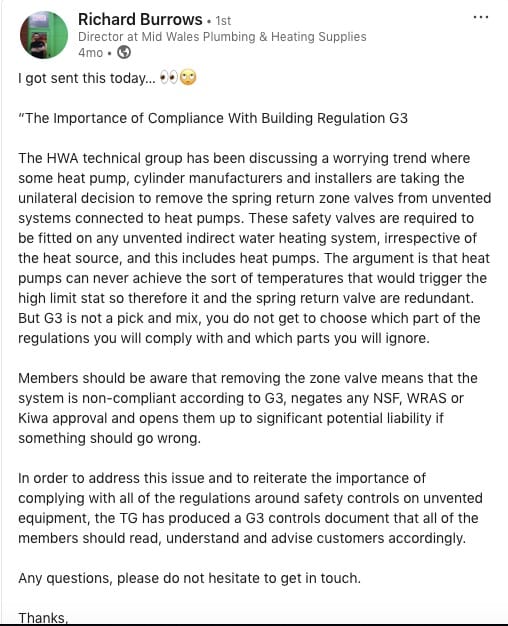
The email Richard was sent illustrates a complete lack of understanding from an Association between G3 guidance (found in the Approved Document G, and the actual requirements of the Building Regulations 2010
Richard replied by informing the HWA what the actual requirements are:
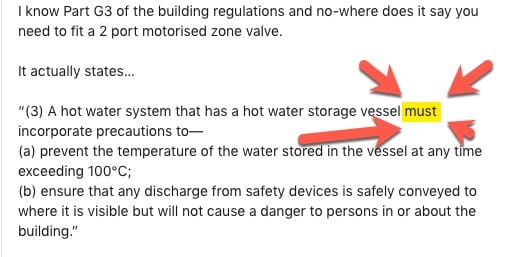
The 2010 Building Regulations state what you ‘must’ do. The Guidance suggests what you ‘should’ do. The guidance is very clear you do not have to follow the guidance.
Confusion with numbers
I think where so many go wrong is they read an approved document, see numbers with decimal points against some paragraphs, and think these are actual regulations. They get mesmerised by the numbers. Numbers make things look official. But in this case they are just their to help people navigate the text within an approved document. That’s all they are. And then there is the word ‘SHOULD’
Confusion with the words: ‘COULD', ‘SHOULD’ & ‘MUST’
The regulations tell us what MUST be done. The guidance uses the word ‘SHOULD’ which is the correct word to use but it causes mass confusion. I REPEAT, IT CAUSES MASS CONFUSION. It so, so does!
The word sounds quite dramatic doesn’t it. It makes us think something MUST be done. But it does not mean that. It never has and it never will, despite what a recent guest on an Installer Online webinar suggested.
Some have asked if ‘COULD’ would be a better word to use in an approved document if guidance is just guidance and not something which must be done. The answer is NO. The word ‘SHOULD’ is used because it denotes what the industry currently thinks is best practice to meet the building regulations. The word ‘COULD does not really do that. It gives no real indication of what industry feels is best practice. It’s a bit wishy washy.
Now lets take a closer look at a this clause I wrote in the paragraph above: “SHOULD’ is used because it denotes what the industry currently thinks is best practice”
SO, the question is: who denotes what current best practice is: it’s a combination of everyone involved in the heating sector but with a very important caveat: on-the-ground engineers have the greatest vantage point of what works best and what doesn’t. Manufacture’s (with commercial interests) and trade bodies (also with interests) in no way shape or form have a better understanding of what best practice is than the cohort of people out there doing this stuff day in and day out. The industry is innovating. The engineers are at the front end of that innovation. Listen to them. It helps.
You’ll find this interesting. Below, is the front page inside an edition of the 1970 ‘Guide’ published by the Institute of Heating and Ventilation Engineers (IHVE). The IHVE (knew their stuff) and is the precursor to the CIBSE. Originally, the books being published by IHVE (which Building Services Engineers across the country used) were called: Guide to Current Practice. They then changed the title.
Take a look at the last highlights I have done in the third paragraph of the foreword.
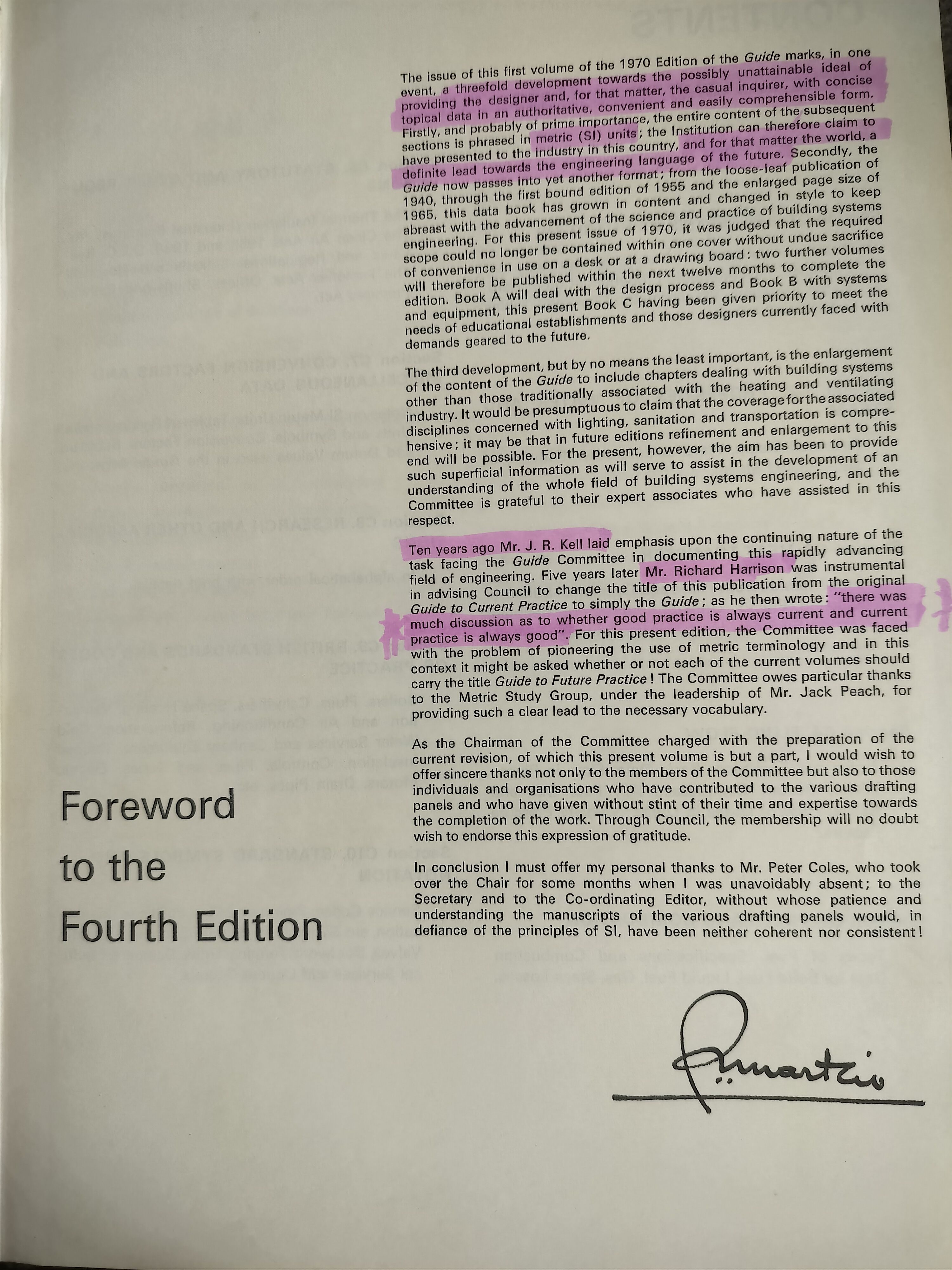
Image of the Foreword in the 1970 edition of the IHVE ‘GUIDE’
We are in for a bumpy ride folks with the heating transition. As you can see in the image above, even back in the 60s and 70s the sector was viewed as a ‘rapidly advancing field of engineering’… It’s nothing compared to now. It’s changing fast. And manufacturers, trade bodies and media will have to adapt and change just as much as engineers are expected too. Or you risk letting engineers and the transition down.
We need to solve the communication crises. Too many entities are inadvertently or blatantly (which is worrying) trying to mesmerise engineers with either marketing messages which contravene the laws of physics or with messages which contravene the Building Regulations. We have an information dissemination industry within the heating sector which is growing fast and becoming even more heterogeneous and dynamic. It’s pushing out the wrong information far too often.
We are in a bit of a mess, but we’ll sort it…engineers usually do ; )
P.S. JUST AS SOME GOOD CAME FROM FRANK MESMER’S PSEUDOSCIENCE (E.G. BETTER WAYS OF RESEARCHING SCIENCE & THE DOUBLE BLIND STUDY) SOME REAL GOOD CAN BE ENGENDERED VIA A COMPANY LIKE ADEY. THEY ARE IN A POWERFUL POSITION. THEY HAVE THE EAR OF MANY HEATING ENGINEERS. THEY ARE IN A GOOD POSITION TO EDUCATE THEM IN ALL MANNER OF THINGS. REACH OUT ADEY TO THE GUILD. LET US HELP YOU HELP THE INDUSTRY
The Guild of Master Heat Engineers is supported by our Patrons.

Learn more about our Patrons here.
Nathan
Subscribe to get more newsletters like this, if you haven’t already.