New Build Modernisation: Solving a 2016 Design Dilemma in Ceredigion with Open-Loop Simplicity
A master heat engineer case study
Helping YOU find good heating engineers. We share case studies from engineers in the Guild of Master Heat Engineers to help people find top installers, help gas and oil engineers increase their knowledge around heat pumps, and provide a solution for third-sector professionals to understand the industry better.
Installio powers the The BetaTeach newsletter.
Overview
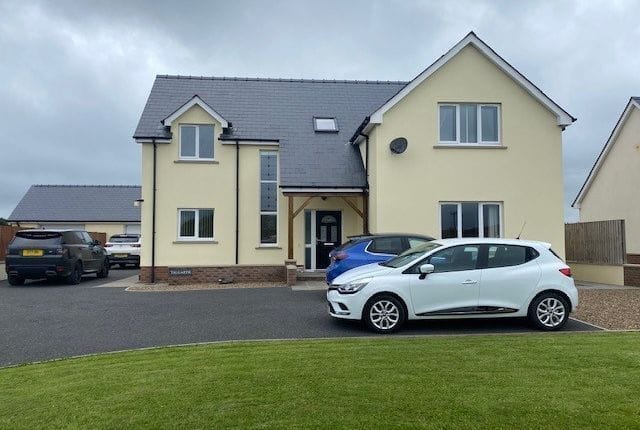
A 146m² timber-framed property, constructed in 2016, underwent a significant heating system overhaul in the summer of 2024. Despite its modern construction, the home suffered from persistent comfort issues and high running costs. This case study explores how a transition from a poorly integrated 13kW unit to a precisely sized 5kW Vaillant aroTHERM Plus, combined with an open-loop design, transformed the property’s efficiency.
Master Heat Engineer
Rhodri J Jones at Helyg Heating |  |
Key Specifications
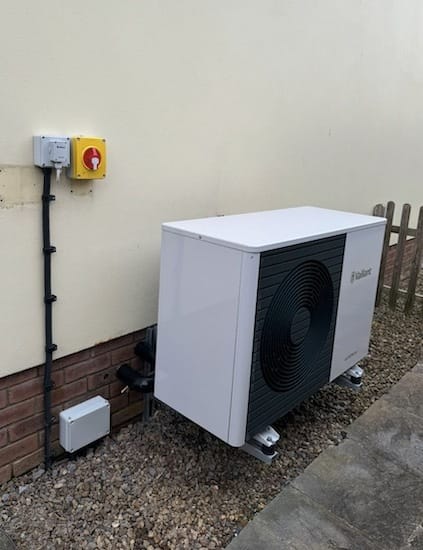
Heat Pump: Vaillant aroTHERM plus 5kW (Wall Mounted)
Building Load: 4.73kW @ -3°C
Hot Water Storage: Joule 300L High-Gain Twin Coil
System Layout: Fully Open-Loop, single zone
Heat Distribution: Underfloor & radiators
Control: Vaillant aroTHERM plus 5kW (Wall Mounted)
Building Type/Size: 146m² timber-framed property (built 2016)
Design Flow Temp: 40°C
The Challenge: Overcoming Poor Design in a High-Spec Home
While the property was well-built by a reputable local company, the original 13kW Grant heat pump installation proved problematic. The unit was significantly oversized for a calculated heat loss of just 4.73kW at -3°C, leading to chronic short-cycling where the unit would run for only three minutes before shutting down. Furthermore, the system lacked hot water priority and featured a complex arrangement of underfloor heating (UFH) mixing valves and multiple pumps. These components created hydraulic complexity that prevented the heat pump from operating within its efficient range, leaving the occupants with a home that never felt truly comfortable.

Oversized Grant Heat Pump
System Design
The engineering team focused on "stripping back" the complexity. A technical assessment confirmed that the existing radiators and pipework were already sized appropriately to deliver the required heat at a low flow temperature of 40°C, allowing the emitters to be retained without modification. The new Vaillant aroTHERM plus was wall-mounted using a specialised kit, and the existing primary pipework was retained and fitted with antifreeze valves to protect the external circuit. To improve the functional use of the home, the new 300-litre Joule cylinder was relocated to the right-hand side of the airing cupboard. This move was specifically designed to free up floor space and provide the customers with a more practical storage layout. This required lifting the floor and redirecting pipework to suit the new orientation. The underfloor mixing valves and pumps were removed, and the thermostats and actuators were decommissioned to allow the system to run as a single open-loop zone. The existing two-panel solar thermal system was retained and re-piped to the new cylinder, while the hot water return pump was integrated into the SensoComfort control logic.
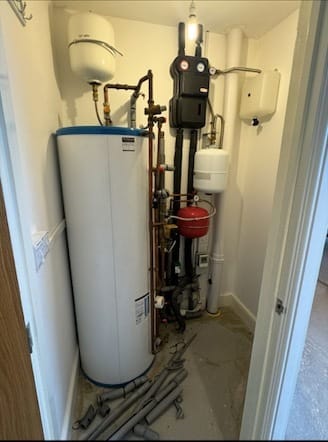
Old configuration
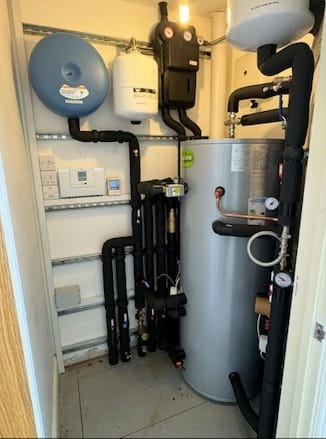
New configuration
Performance and Results
Following the 2024 installation, the system was fine-tuned during the winter. The weather compensation curve was adjusted to maintain a stable internal comfort temperature of 20°C. The first annual service in the summer of 2025 confirmed the success of the minimalist design. Data from the Vaillant user interface shows the system is performing with a working figure of 4.1. The occupants now report a comfortable, stable home environment with significantly improved running costs compared to the original 2016 installation.
Estimated Heat Loss (kW) at Various Outside Temperatures
Temp | kJ/Sec | Temp | kJ/Sec |
|---|---|---|---|
-3°C | 4.7 | 6°C | 2.9 |
-1°C | 4.3 | 10°C | 2.1 |
0°C | 4.1 | 13°C | 1.6 |
3°C | 3.5 | 16°C | 0.9 |
Thanks to the Patrons
The Guild of Master Heat Engineers is supported by our Patrons…and I am glad to announce we have a new Patron onboard: ESBE group (their Logo coming soon)

Learn more about our Patrons here.
Closing Thoughts
When people hear the word wizard, they often picture something from Lord of the Rings. I do not. When I think of wizards, I think of Wales and more specifically two engineers based not far from one another who I often refer to as the Welsh Wizards. One is Steve Calvert. The other is Rhodri at Helyg Heating.
Wales, of course, has a long standing association with wizardry. It is the land most closely linked with Merlin, a figure rooted in Welsh legend and folklore, known for wisdom, foresight and mastery rather than spectacle. While Rhodri is not working from a stone circle, what he delivers through well designed heating and ventilation systems can feel just as remarkable when you understand the level of skill involved.
Rhodri is widely respected by his peers and truly exemplifies what the Guild is about. He is highly skilled in heat pump design, commissioning and installation, and is also an expert in mechanical ventilation with heat recovery and solar thermal systems. This depth and breadth of knowledge, combined with a clear commitment to doing things properly, makes him an outstanding engineer and a genuine asset to the UK heating sector.
Engineers of this calibre are exactly why standards matter. If I were ever unable to install systems myself, Rhodri is someone I would trust without hesitation to carry out the work to the highest possible standard.
There is also a wider question that deserves attention. With heat pump manufacturers competing fiercely to secure a foothold in the new build market, speed and market share can too easily begin to outweigh system performance and long term outcomes. This raises an uncomfortable but necessary challenge. Should manufacturers be doing far more to prevent situations like this from occurring in the first place. When competition is intense, responsibility can become diluted, with design assumptions passed down the chain and consequences felt by occupants and installers alike. If the industry truly wants trust, adoption and long term success, then manufacturers must see high quality design support, installer competence and real world accountability not as optional extras, but as essential parts of winning that competition.
Have a great week everyone.
Nathan
Subscribe to get more newsletters like this, if you haven’t already.