Can Existing Radiators Work with a Heat Pump? Essex aroTHERM plus Retrofit Achieving SCOP 3.7
A master heat engineer case study

Nathan G
March 13, 2026
Helping YOU find good heating engineers. We share case studies from engineers in the Guild of Master Heat Engineers to help people find top installers, help gas and oil engineers increase their knowledge around heat pumps, and provide a solution for third-sector professionals to understand the industry better.
Installio powers the The BetaTeach newsletter.

Flat roof installation of Vaillant aroTHERM plus 7kW heat pump in Essex. System operates as a single open loop with a measured SCOP of 3.7.
Overview
This project demonstrates how a Vaillant aroTHERM plus 7kW air source heat pump can operate efficiently with existing radiators and underfloor heating, achieving a measured SCOP of 3.7 under real-world conditions.
The retrofit was carried out in Essex, with the heat pump installed on the flat roof for optimal airflow and a discreet footprint.
The property has a heated floor area of 181.7 m² and the system was designed to maintain 21°C indoors at an outdoor design temperature of −2°C, with a design flow temperature of 45°C at −2°C.
Monitoring is provided via a Sontex heat meter and OpenEnergyMonitor, allowing continuous measurement of electrical input, thermal output, and real-time COP.
Engineering Context
Many heat pump installations introduce buffers, low-loss headers, or hydraulic separation when existing heating systems present flow restrictions.
However, these additional components can increase complexity, reduce efficiency, and increase installation cost.
This case study demonstrates how careful hydraulic design and pipework optimisation can allow a heat pump system to operate as a single open loop circuit, without hydraulic separation, while achieving high efficiency and maintaining existing radiators.
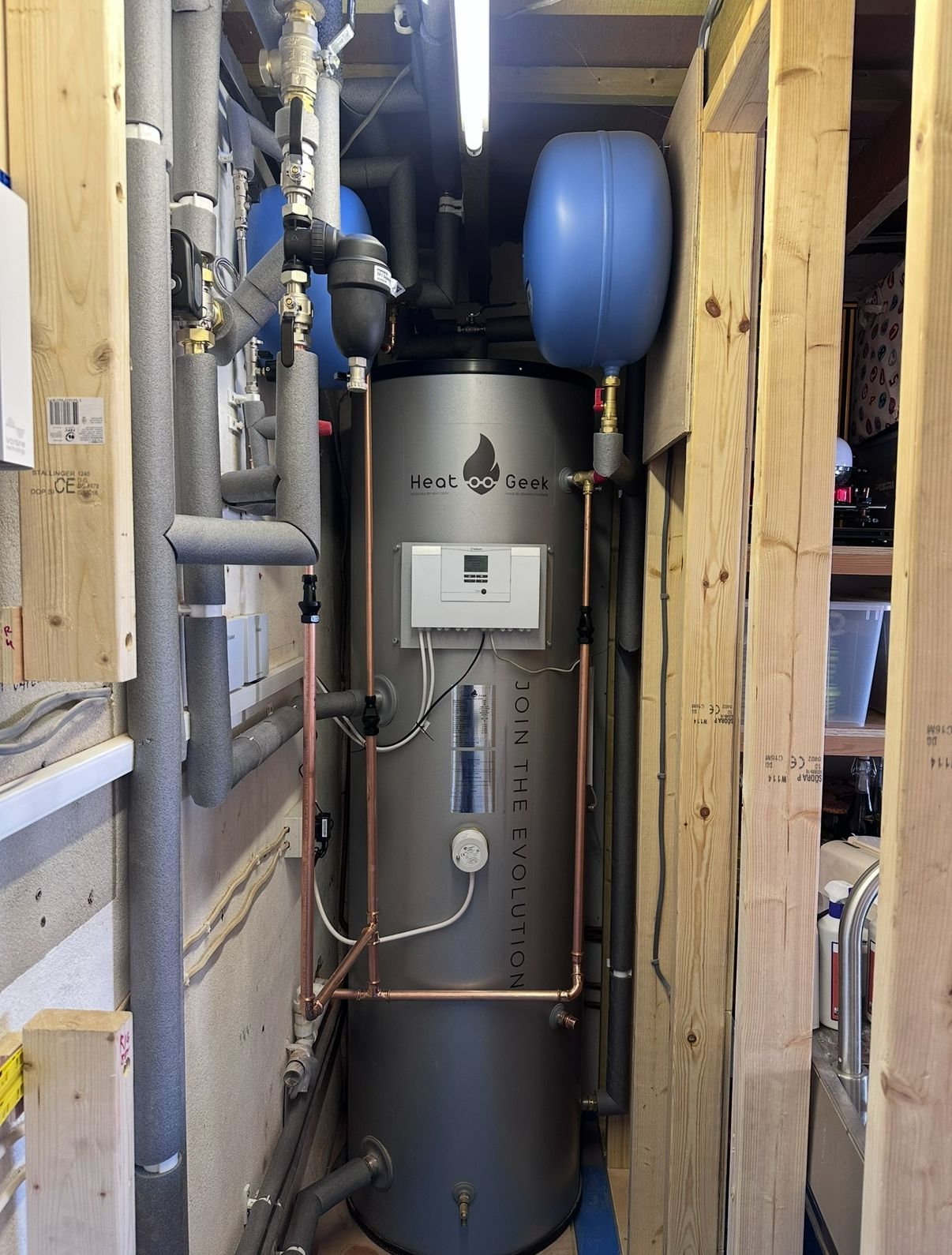
Close-up of the Newark cylinder with Heat Geek design and internal pipework, part of a Master Heat Engineer Essex heat pump retrofit
Master Heat Engineer
This project was designed and installed by Bromley Energy, a Master Heat Engineer, whose approach prioritises:
|  Michael Waring, Master Heat Engineer at Bromley Energy, responsible for high-performance heat pump installations across Bromley, North Kent, and South East London. |
Key Specifications
Parameter | Value |
|---|---|
Location | Essex |
Heat Pump | Vaillant aroTHERM plus 7kW |
Property Floor Area | 181.7 m² |
Internal Design Temp | 21°C |
Outdoor Design Temp @ -2°C | 6.8 kW Heat Loss |
Design Flow Temp | 45°C at −2°C |
Emitters | Existing radiators and UFH retained |
Hydraulic Configuration | Open loop, no buffer, no low-loss header, no hydraulic separation |
Controls | Vaillant sensoCOMFORT, weather compensation |
Hot Water Cylinder | Newark Heat Geek Super Cylinder |
Monitoring | Sontex heat meter + OpenEnergyMonitor |
Measured Performance | SCOP 3.7 |
The Challenge:
The homeowner wanted to transition to low-carbon heating while integrating the heat pump with:
a large solar PV array
battery storage
a time-of-use electricity tariff
domestic hot water immersion connected to a MyEnergi Eddi solar diverter
Challenges included:
underfloor heating manifold with separate circulation pump and blending valve, creating mixed temperatures and hydraulic separation
pipework restricting flow to the index circuit, which could have required additional components if left unchanged
System Design & Engineering Approach
The installation was engineered as a complete hydraulic circuit, not just a simple heat source replacement.
Key design decisions:
Heat loss calculations confirmed the property could operate at 45°C flow temperature with existing emitters.
Pipe sizing calculations determined that sections of the distribution system needed upsizing to ensure the circulator could overcome system resistance.
Hydraulic simplifications included:
Removal of the UFH circulation pump and blending valve
Increasing distribution pipe diameters to 28mm in key sections
Reconfiguring the system as a single open loop
Controls and monitoring:
Weather compensation ensures flow temperature is automatically reduced when outdoor temperatures rise
Sontex heat meter allows continuous performance monitoring
External pipework insulated with Primary Pro insulation to maintain efficiency.
Installation
Installation was completed with minimal disruption, including:
Removal of UFH pump and blending valve
Upgrading distribution pipework
Installation of a Newark Heat Geek Super Cylinder
Installation of Sontex heat meter
External pipework insulation
System balancing and commissioning
The heat pump was installed on the flat roof, providing excellent airflow and a discreet footprint.
Measured System Performance
The system is continuously monitored using OpenEnergyMonitor:
Electrical input
Thermal output
Real-time COP
Seasonal performance trends
Results:
SCOP 3.7 under real-world conditions
No radiator replacements required
Fully open loop heating circuit
Integrated with solar PV and battery storage for overnight load shifting
Design Insight
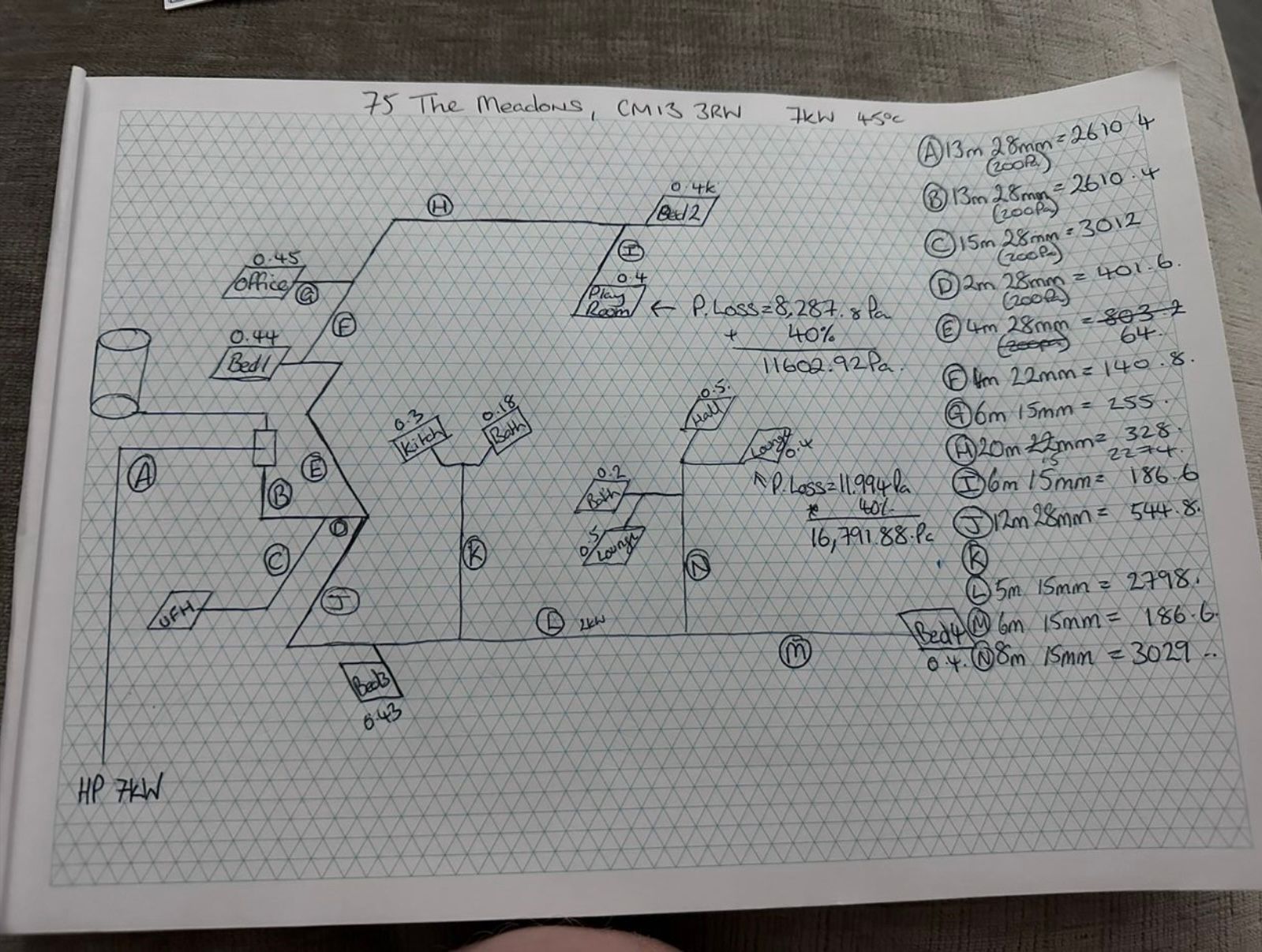
Michael Waring’s hand-drawn initial pipe sizing calculations, guiding the hydraulic upgrades for the Essex heat pump retrofit.
Initial pipe sizing calculations revealed the index circuit resistance exceeded the pump’s residual head, which would normally require hydraulic separation.
By upsizing pipework and removing unnecessary UFH components, the system operates as a single open loop circuit:
Radiators and underfloor heating operate at the same flow temperature
Weather compensation maximises efficiency throughout the season
Complexity is reduced while performance is validated with real-world measured data
Key Engineering Lessons
Before selecting equipment, assess the heating system as a complete hydraulic circuit, rather than simply replacing the existing heat source.
Perform accurate heat loss and pipe sizing calculations to ensure the system can operate within the available residual head of the heat pump circulation pump.
Simplify the hydraulic layout: remove unnecessary pumps, blending valves, buffers, or low-loss headers where possible.
Upsize distribution pipework to reduce system resistance and avoid additional hydraulic components.
Integrate controls with weather compensation to optimize flow temperatures for efficiency across the heating season.
Monitor, if possible, performance in real-time using meters and data logging to validate SCOP and system performance.
Retain existing emitters where possible, as careful design can allow radiators and underfloor heating to operate efficiently without replacements.
Design for minimal disruption to the homeowner while maintaining high system efficiency.
Estimated Calculated Heat Loss (kW) at Various Outside Temperatures
Temp | kJ/Sec | Temp | kJ/Sec |
|---|---|---|---|
-3°C | 7.1 | 6°C | 4.4 |
-1°C | 6.5 | 10°C | 3.3 |
0°C | 6.2 | 13°C | 2.8 |
3°C | 5.3 | 16°C | 1.5 |
Thanks to the Patrons
The Guild of Master Heat Engineers is supported by our Patrons.

Learn more about our Patrons here.
Closing Thoughts
This Essex retrofit demonstrates that high-performing heat pump systems are achieved through smart engineering, not added complexity. By carefully addressing hydraulic layout and system resistance, Bromley Energy were able to:
Retain existing radiators and underfloor heating
Avoid buffers, low-loss headers, and hydraulic separation
Achieve a measured SCOP of 3.7 under real-world conditions
Provide transparent performance data via OpenEnergyMonitor
These design decisions, guided by a Master Heat Engineer, show that expert engineering and real-world monitoring deliver efficient, low-carbon heating without unnecessary components or disruption. This installation highlights how a Master Heat Engineer’s approach: thoughtful, measured, and data-driven consistently achieves high-performance results.
Have a great week everyone.
Nathan
Subscribe to get more newsletters like this, if you haven’t already.