417% Efficiency: Viessmann Vitocal 150-A Heat Pump & Solar PV in a 1930s Walthamstow Retrofit
A master heat engineer case study

Nathan G
March 31, 2026
Helping YOU find good heating engineers. We share case studies from engineers in the Guild of Master Heat Engineers to help people find top installers, help gas and oil engineers increase their knowledge around heat pumps, and provide a solution for third-sector professionals to understand the industry better.
Installio powers the The BetaTeach newsletter.
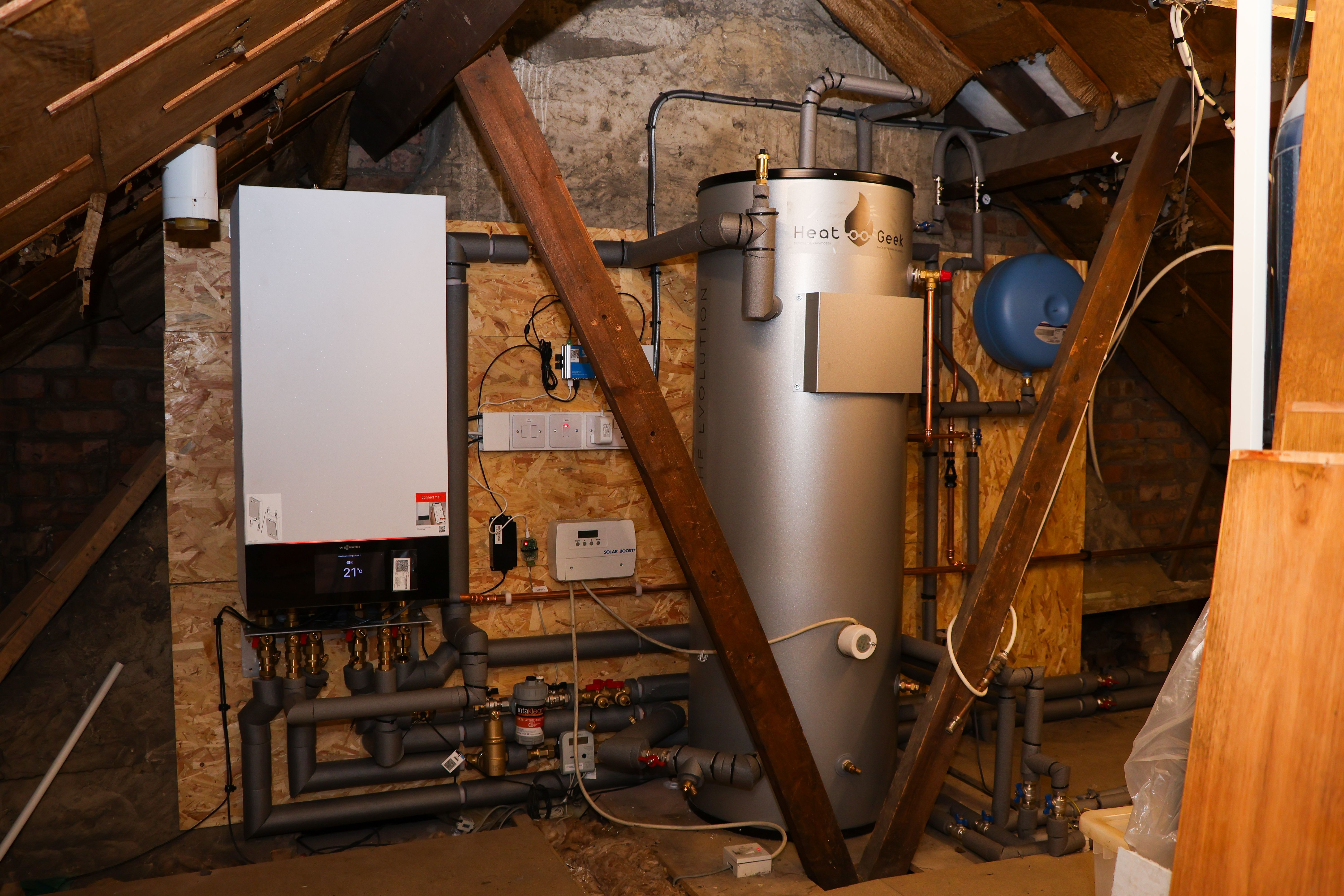
The internal plant room located in the loft space. The configuration features a 250L Newark (HG) high-performance cylinder and an integrated defrost buffer to maintain indoor thermal stability. Weather compensation via a north-facing sensor modulates the 35°C design flow temperature.
System Snapshot
Technology: 13kW Viessmann Vitocal 150-A (R290)
Location: Walthamstow, London (1930s Semi-Detached)
Design Flow Temperature: 35°C at -1.7°C DOT
Measured Efficiency: 417% (Overall System COP)
Energy Integration: Solar PV + Battery Storage + ASHP
Overview
The replacement of an unreliable gas boiler in a 1930s semi-detached property facilitates a transition to low-carbon heating. The installation integrates an air source heat pump with existing solar PV and energy storage to provide constant thermal comfort.
Property Background & Fabric
The property is a 1930s semi-detached home with various modernised fabric improvements. The previous heating provision consisted of a five-year-old gas boiler positioned in a loft space, a configuration that limited user accessibility and system transparency. The project required a full decarbonisation of the heating system to improve operational efficiency.
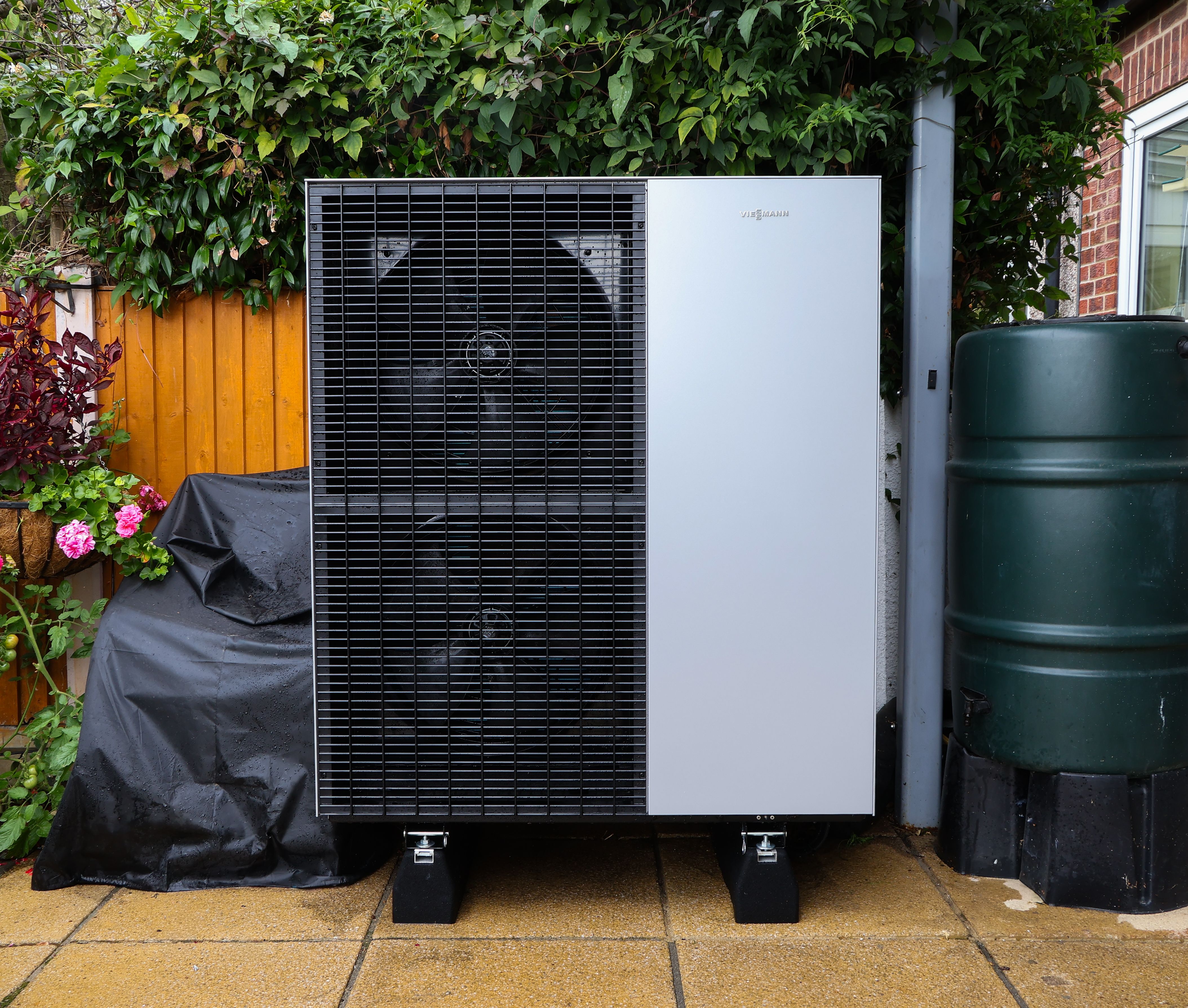
While the R290 (Propane) refrigerant allows for high-flow temperatures, this system is engineered for maximum efficiency with a Design Flow Temperature of 35°C. By matching the 9.2kW heat loss at a -1.7°C Design Outdoor Temperature with low-temperature emitters, the installation achieves a measured COP of 4.17.
Master Heat Engineer
 |
/
Key Specifications
Component | Technical Detail |
Heat Pump Model | Viessmann Vitocal 150-A (13kW) |
Refrigerant | R290 (Propane) |
Design Outdoor Temperature (DOT) | -1.7°C |
Design Flow Temperature | 35°C |
Heat Loss (Total) | 9.2kW |
Hot Water Cylinder | 250L Newark (HG) High-Performance Cylinder |
Primary Energy Integration | Solar PV with Battery Storage |
Control Strategy | External Weather Compensation (North-Facing Sensor) |
Hydraulic Configuration | Open Loop with Integrated Defrost Buffer |
The Engineering Challenge:
Current industry narratives often suggest heat pump technology is ineffective for UK housing stock. However, a first-principles investigation reveals that proper design is the critical variable. Alex Winters of Libtek Heating & Renewables conducted a room-by-room heat loss calculation, identifying a requirement of 9.2kW at the design outdoor temperature of -1.7°C. This empirical approach ensures the unit matches the building's actual thermal envelope.
System Design & Innovation: Integrating PV with ASHP
The design addresses the integration of a 13kW heat pump with existing solar PV and battery storage using a 250L cylinder. The system utilises a Viessmann Vitocal 150-A (R290), selected for the robust build and integrated defrost buffer. This configuration ensures that heat is not drawn from the internal emitter circuit during defrost cycles, maintaining stable indoor temperatures. The hydraulic design required the replacement of four radiators and the addition of two more to meet the heat loss at lower flow temperatures. Weather compensation via a north-facing external sensor modulates the system output in real time.
Performance & Evidence
System Efficiency: The installation operates at an overall efficiency of 417%.
DHW Strategy: Excess solar PV generation maintains the 250L Newark (HG) cylinder at 40°C to 45°C, with the ASHP providing the final lift to 50°C.
Operational Cost: The heat pump consumes 100kWh over the summer months for hot water, at a cost of approximately £30.
Environmental Impact: Estimated annual CO2 reduction is 4.8 tonnes.
Estimated Heat Loss (kW) at Various Outside Temperatures
Temp | kJ/Sec | Temp | kJ/Sec |
|---|---|---|---|
-3°C | 9.7 | 6°C | 6.1 |
-1°C | 8.9 | 10°C | 4.5 |
0°C | 8.5 | 13°C | 3.2 |
3°C | 7.3 | 16°C | 2.0 |
Closing Reflections
Alex is one of my favourite engineers. He has a passion for learning and trying different manufacturer’s heat pumps. He's very busy, in fact I still haven't managed to get him on the podcast, which we both joke about.
As a member of the Guild of Master Heat Engineers network, Alex Winters is pushing boundaries and doing some extremely interesting heating installs.
Thanks to the Patrons
The Guild of Master Heat Engineers is supported by our Patrons.

Learn more about our Patrons here.
Have a great week everyone.
Nathan
Subscribe to get more newsletters like this, if you haven’t already.